
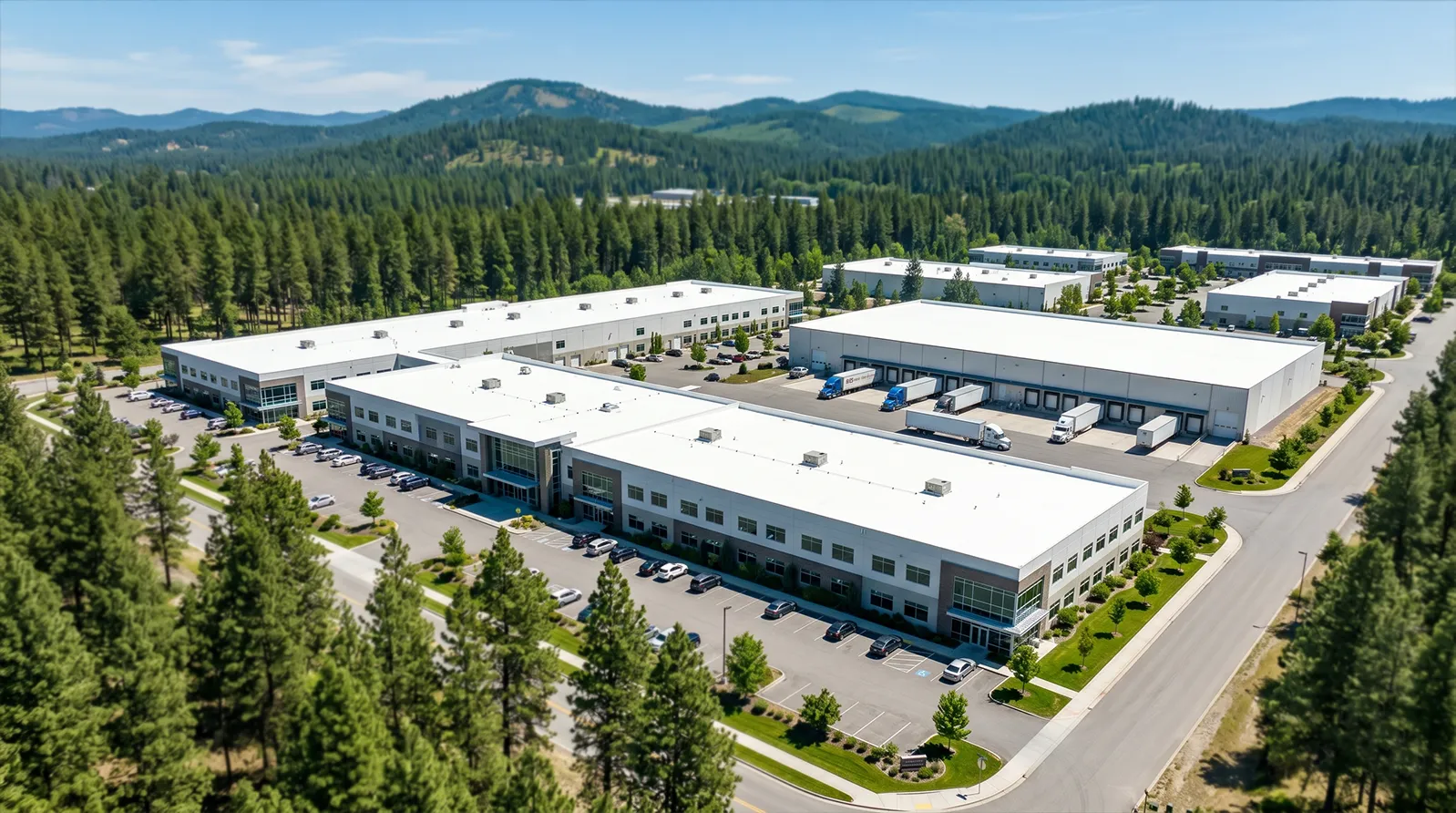
At a Glance: What Is the Best Commercial Roofing System?
The best commercial roofing system depends on the building type, roof slope, drainage, snow exposure, insulation needs, rooftop equipment, foot traffic, budget, and how long the owner plans to keep the property.
For many North Idaho commercial and low-slope buildings, the most common options are:
- TPO roofing for energy-conscious low-slope roofs and broad commercial use.
- EPDM roofing for flexible rubber membrane performance and proven low-slope applications.
- PVC roofing for stronger chemical and grease resistance in certain commercial environments.
- Modified bitumen roofing for asphalt-based multi-layer performance.
- Built-up roofing for traditional multi-ply commercial roof assemblies.
- Metal roofing for sloped commercial, agricultural, shop, warehouse, and mixed-use buildings.
- Roof coatings or restoration systems when the existing roof is a good candidate and full replacement is not yet required.
A “flat roof” should not be truly flat. Low-slope commercial roofs still need positive drainage. NRCA recommends membrane, liquid-applied, and SPF roof systems be sloped to provide positive roof drainage, and new construction must meet applicable code requirements for minimum slope.
For local commercial roofing support, visit SkyRight’s commercial roofing services in Coeur d’Alene, Post Falls roofing page, roof repair vs replacement guide, North Idaho roof maintenance calendar, and roof replacement cost guide.
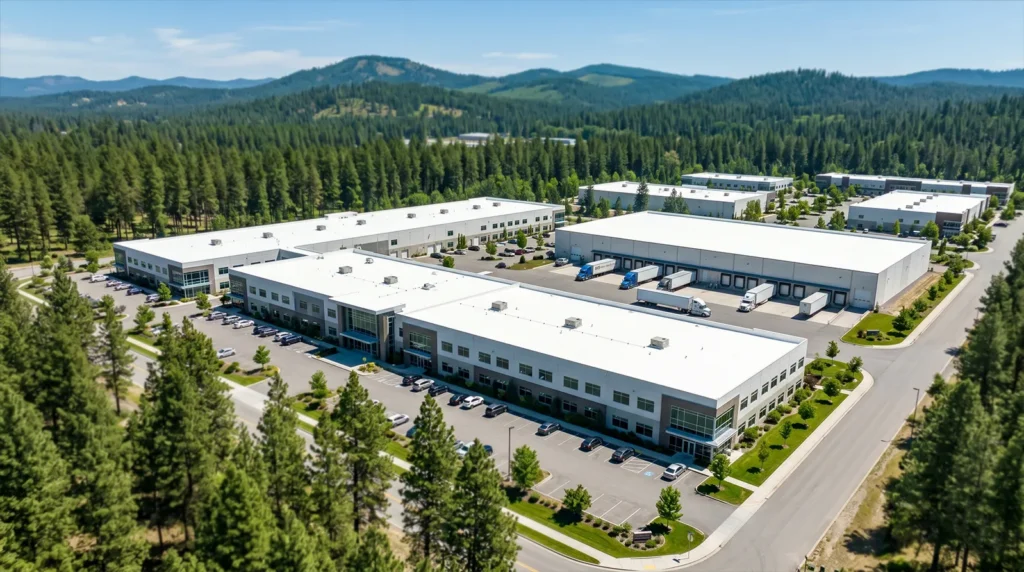
Quick Answer: Which Flat Roof System Should a North Idaho Building Owner Choose?
Use this simple decision table as a starting point.
|
Building Situation |
Roofing System to Consider First |
Why |
|
Standard low-slope commercial building |
TPO or EPDM |
Common, practical membrane options for many commercial roofs |
|
Restaurant or grease-exhaust exposure |
PVC |
PVC is often considered where chemical or grease resistance matters |
|
Older asphalt-based commercial roof |
Modified bitumen or roof restoration |
May fit existing roof type and repair history |
|
Warehouse, shop, or light industrial building |
TPO, EPDM, metal, or coating |
Depends on slope, structure, insulation, and drainage |
|
Sloped commercial roof |
Metal roofing or architectural asphalt |
Depends on pitch, appearance, snow, and budget |
|
Roof with ponding water |
Drainage correction before system selection |
Material alone will not fix poor drainage |
|
Roof with many rooftop units |
Durable membrane and detailed flashing plan |
Penetrations are common leak points |
|
Roof near end of life |
Replacement inspection |
Coatings cannot fix saturated insulation or failed decking |
|
Roof still structurally sound |
Coating or restoration evaluation |
May extend service life if the roof is a good candidate |
Important rule: The best commercial roof is not chosen by material alone. It is chosen by the building’s slope, drainage, insulation, snow load, rooftop equipment, code requirements, and existing roof condition.
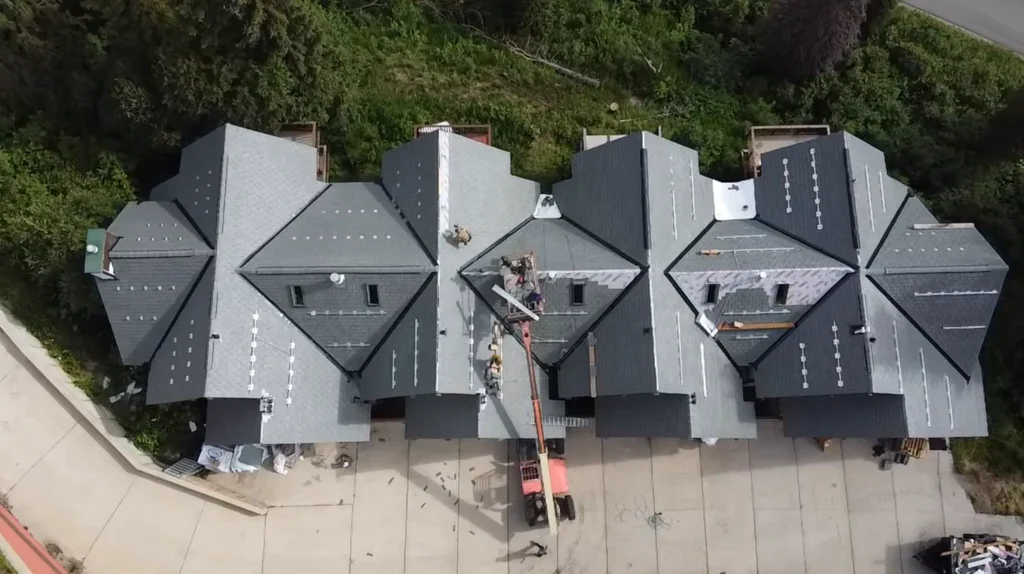
What Counts as Commercial Roofing?
Commercial roofing includes roof systems installed on buildings such as:
- offices;
- retail buildings;
- warehouses;
- restaurants;
- medical offices;
- churches;
- schools;
- apartment buildings;
- mixed-use properties;
- shops and garages;
- light industrial buildings;
- agricultural or storage buildings.
Commercial roofing is different from residential roofing because commercial buildings often have larger roof areas, lower slopes, more rooftop equipment, more drainage complexity, more code and insulation requirements, and higher consequences if leaks interrupt business operations.
A commercial roof is not only a weather barrier. It can affect:
- building operations;
- inventory protection;
- tenant comfort;
- energy performance;
- insurance risk;
- maintenance costs;
- property value;
- business continuity.
For local service information, visit SkyRight’s commercial roofing services in Coeur d’Alene.
What Counts as Flat Roofing?
Flat roofing usually means low-slope roofing, not a roof with no slope at all.
Low-slope roofs need controlled drainage through internal drains, scuppers, gutters, or tapered insulation systems. Without drainage, ponding water can stress seams, increase leak risk, collect debris, freeze in winter, and shorten roof life.
Flat Roof vs Low-Slope Roof
|
Term |
What It Usually Means |
Why It Matters |
|
Flat roof |
Common homeowner/business-owner phrase |
Often used casually, but technically misleading |
|
Low-slope roof |
More accurate roofing term |
Means the roof has limited slope but still needs drainage |
|
Positive drainage |
Water moves off the roof as designed |
Critical for preventing ponding and freeze-thaw damage |
|
Ponding water |
Water remains on the roof after rain or thaw |
Can indicate drainage or slope problems |
A roofing contractor should evaluate drainage before recommending any low-slope roof material.
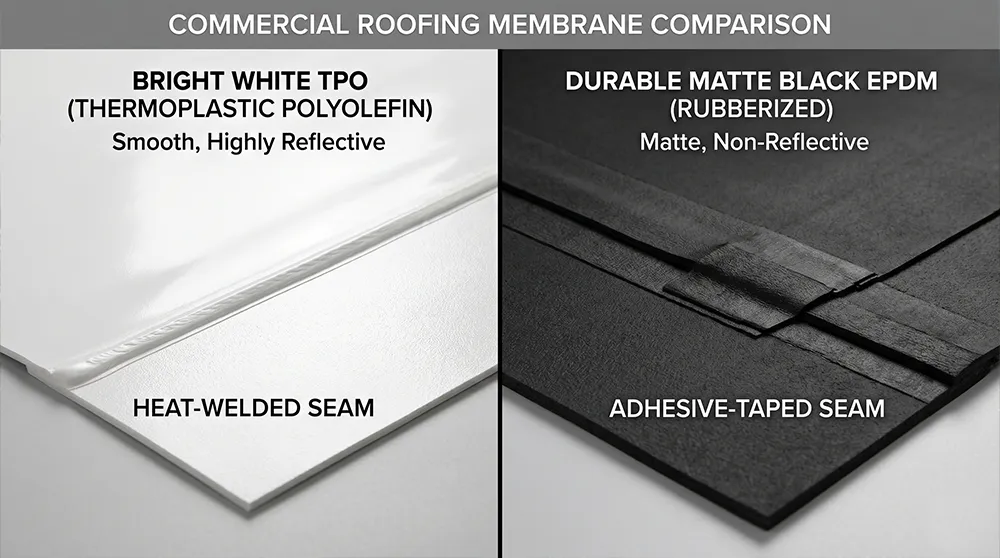
Commercial Flat Roofing Systems Compared
|
System |
Best Fit |
Strengths |
Watchouts |
|
TPO |
Standard commercial low-slope roofs |
Reflective, common, weldable seams, broad use |
Installation quality and detailing matter |
|
EPDM |
Low-slope buildings needing flexible rubber membrane |
Proven, flexible, large sheets |
Dark membrane may absorb heat unless coated or specified differently |
|
PVC |
Restaurants, grease exposure, chemical concerns |
Strong seam welding and chemical resistance use cases |
Usually higher cost than some alternatives |
|
Modified bitumen |
Small commercial, asphalt-based roofs, roof sections with more foot traffic |
Multi-layer asphalt-based durability |
Heat, torch, or adhesive details vary by system |
|
Built-up roofing |
Traditional commercial roofs |
Multi-ply redundancy |
Heavy, labor-intensive, less common for some modern replacements |
|
Metal roofing |
Sloped commercial, shops, warehouses, agricultural, mixed-use buildings |
Durable, snow-shedding potential, long-term value |
Snow-slide planning, fasteners, trim, and penetrations matter |
|
Roof coating |
Existing roof restoration candidate |
Can extend service life when conditions are right |
Not suitable for saturated, failing, or structurally compromised roofs |
IKO’s commercial flat roofing guide groups asphalt-based commercial systems into built-up roofing, modified bitumen, and hybrid systems, while other low-slope resources commonly discuss EPDM, TPO, PVC, and related membrane options.
Confused about which flat roof system fits your building?
Choosing between TPO, PVC, and EPDM depends entirely on your building’s usage, chemical exposure, and energy goals. Don’t risk a premature failure. Let our commercial roofing engineers help you select the optimal system for your property.
TPO Roofing
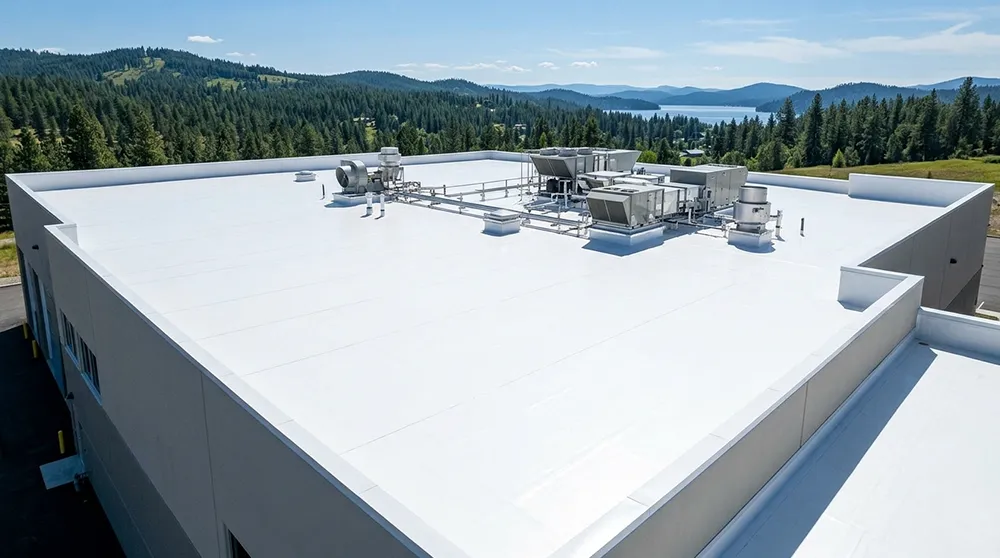
TPO stands for thermoplastic polyolefin. It is a single-ply membrane commonly used on low-slope commercial roofs.
TPO Roofing Is Often a Good Fit For:
- offices;
- retail buildings;
- warehouses;
- light commercial buildings;
- low-slope roof sections;
- buildings where reflectivity matters;
- commercial properties needing a practical membrane roof.
TPO Strengths
- reflective white membrane options;
- heat-welded seams;
- common commercial availability;
- practical cost range;
- good fit for many low-slope roof projects;
- compatible with insulation and tapered drainage designs.
TPO Watchouts
- installation quality matters;
- seams, penetrations, edges, and rooftop units must be detailed correctly;
- ponding water should be addressed;
- roof traffic should be managed with walk pads where needed;
- membrane thickness and manufacturer specifications matter.
TPO is often a strong first option for standard low-slope commercial roofs in North Idaho, especially when the roof has proper drainage and rooftop penetrations are detailed correctly.
EPDM Roofing
EPDM is a synthetic rubber roofing membrane used on low-slope roofs. CRCA describes EPDM as a rubber material supplied in large sheets that can be loose laid and ballasted or adhered, with seams handled by adhesives and related detailing.
EPDM Roofing Is Often a Good Fit For:
- low-slope commercial buildings;
- roofs with fewer complicated details;
- buildings where membrane flexibility matters;
- owners who want a proven low-slope roof material.
EPDM Strengths
- proven commercial track record;
- flexible membrane;
- available in large sheets;
- practical for many low-slope roofs;
- good performance when properly installed and maintained.
EPDM Watchouts
- seams and adhesives must be installed correctly;
- dark EPDM can absorb more heat unless specified otherwise;
- punctures and rooftop traffic need attention;
- drainage still matters;
- coatings or ballast may be part of some systems.
EPDM can be a practical choice, but it should be matched to the building’s drainage, energy goals, rooftop equipment, and maintenance expectations.
PVC Roofing
PVC stands for polyvinyl chloride. It is a single-ply membrane used for certain commercial low-slope roofs.
PVC Roofing Is Often a Good Fit For:
- restaurants;
- food-service buildings;
- roofs near grease exhaust;
- certain industrial buildings;
- roofs where chemical resistance is a concern;
- buildings requiring welded seams and durable detailing.
PVC Strengths
- heat-welded seams;
- strong choice for certain grease or chemical exposure environments;
- reflective membrane options;
- good fit for specific commercial applications;
- durable when properly specified and installed.
PVC Watchouts
- often costs more than some TPO or EPDM options;
- not every building needs PVC;
- details around rooftop units and penetrations matter;
- roof traffic and maintenance still matter.
PVC should be considered when the building’s use creates exposure conditions that justify it.
Modified Bitumen Roofing
Modified bitumen is an asphalt-based roofing system reinforced and manufactured in sheets. It is often used on low-slope roofs, especially where a durable multi-layer system is desired.
Modified Bitumen Is Often a Good Fit For:
- smaller commercial roofs;
- low-slope roof sections;
- asphalt-based existing roofs;
- buildings with more service foot traffic;
- roofs where a multi-ply asphalt system is preferred.
Modified Bitumen Strengths
- durable asphalt-based system;
- can offer strong puncture resistance;
- familiar commercial roof category;
- works well in certain repair and replacement situations;
- multiple installation methods depending on system.
Modified Bitumen Watchouts
- seams and laps must be installed correctly;
- heat-applied systems require proper safety and skill;
- reflective surfacing may be needed for energy or heat concerns;
- drainage and flashing remain critical.
Modified bitumen may make sense when the existing roof type, building use, and foot traffic patterns point toward an asphalt-based commercial system.
Built-Up Roofing
Built-up roofing, often called BUR, is a traditional commercial roofing system made from multiple layers of bitumen and reinforcing fabrics.
BUR Is Often a Good Fit For:
- certain traditional commercial buildings;
- properties already using built-up roof assemblies;
- heavy-duty low-slope applications;
- buildings where multi-ply redundancy is valued.
BUR Strengths
- multi-layer system;
- long history in commercial roofing;
- durable when properly installed;
- can provide redundancy through multiple plies.
BUR Watchouts
- heavier than many single-ply options;
- labor-intensive;
- odor and installation disruption may matter;
- may not be the most practical modern choice for every building.
A contractor should evaluate whether BUR, modified bitumen, or a single-ply membrane makes the most sense for the building and budget.

Metal Roofing for Commercial Buildings
Metal roofing can be a strong option for sloped commercial roofs, shops, warehouses, agricultural buildings, garages, and mixed-use properties.
NRCA’s roof slope guidance notes different slope recommendations for metal panel systems, including structural panel and architectural panel roof systems.
Commercial Metal Roofing Is Often a Good Fit For:
- shops;
- warehouses;
- storage buildings;
- agricultural properties;
- sloped commercial roofs;
- mixed-use buildings;
- long-term ownership;
- buildings where snow shedding matters.
Metal Roofing Strengths
- long-term durability potential;
- snow-shedding potential on proper slopes;
- strong fit for shops and warehouse-style buildings;
- premium appearance for certain properties;
- good option for some roof replacements or upgrades.
Metal Roofing Watchouts
- not every low-slope roof is a metal roof candidate;
- snow-slide zones must be planned;
- gutters must be designed for water and snow movement;
- penetrations and trim require skilled detailing;
- exposed-fastener systems need fastener maintenance over time.
For more detail, visit SkyRight’s metal roofing guide and metal roofing services page.
Roof Coatings and Restoration
Roof coatings can be useful when the existing commercial roof is still a good candidate for restoration. They are not a cure for every flat roof problem.
Roof Coatings May Make Sense When:
- the existing membrane is still attached;
- insulation is dry;
- seams and penetrations can be repaired first;
- drainage is acceptable or can be corrected;
- the building owner wants to extend service life;
- full replacement is not yet necessary.
Roof Coatings Usually Do Not Make Sense When:
- insulation is saturated;
- the membrane is failing widely;
- the roof has structural damage;
- ponding water is severe;
- the roof has repeated leaks from multiple sources;
- the deck is damaged;
- the existing system is beyond restoration.
Coating Decision Table
|
Roof Condition |
Coating Candidate? |
Why |
|
Membrane mostly sound |
Possibly |
Repairs and coating may extend service life |
|
Isolated seam issues |
Possibly |
Repair first, then coat if system qualifies |
|
Saturated insulation |
No |
Moisture must be removed; replacement likely |
|
Severe ponding water |
Usually no |
Drainage must be corrected first |
|
Multiple active leaks |
Usually no |
Failure source must be solved first |
|
Structural deck damage |
No |
Coating will not fix structure |
A roof coating should be recommended only after inspection, moisture evaluation, and repair planning.

Cool Roofs and Energy Considerations
Cool roofs can be especially relevant for low-slope commercial buildings with large roof areas. ENERGY STAR explains that cool roofs reflect sunlight and release absorbed heat, using high solar reflectance and thermal emittance to stay cooler.
The U.S. Department of Energy similarly explains that cool roofs are designed to reflect more sunlight than conventional roofs and absorb less solar energy, which can lower building temperature.
Cool Roof Benefits Can Include:
- lower roof surface temperature;
- improved summer comfort;
- reduced heat transfer into the building;
- reflective membrane options;
- possible energy-performance benefits for certain buildings.
Cool Roof Watchouts in North Idaho
Cool roof value depends on the building, insulation, HVAC use, roof type, exposure, and seasonal conditions. In North Idaho, energy performance should be evaluated alongside snow, drainage, insulation, condensation risk, and winter roof behavior.
A reflective membrane is not a substitute for good insulation, proper drainage, or a well-detailed roof system.
North Idaho Snow, Drainage, and Freeze-Thaw Issues
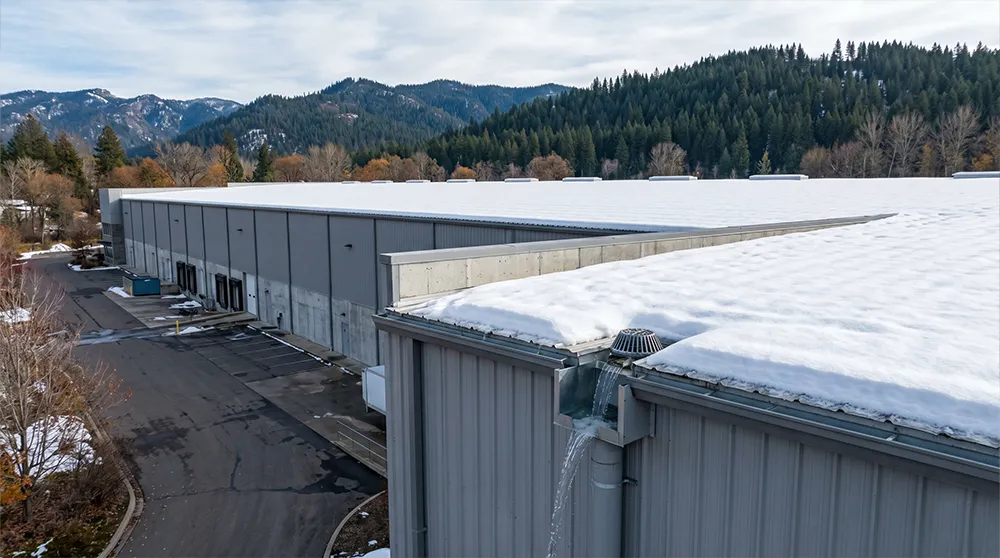
Commercial roofs in North Idaho must be planned around snow and drainage. Low-slope roofs can collect snow differently than steep residential roofs, and freeze-thaw cycles can stress seams, drains, scuppers, edges, flashing, and rooftop equipment.
Kootenai County code includes specific flat-roof snow-load language and notes that buildings on land parcels with higher ground snow loads may need to be designed in accordance with accepted engineering practice.
The University of Idaho’s snow load resource also notes that final design snow loads are the responsibility of the engineer, architect, local building official, and/or contractor in charge of the project.
Winter Risk Areas on Commercial Roofs
|
Risk Area |
Why It Matters |
|
Internal drains |
Can clog or freeze, causing ponding |
|
Scuppers |
Need to remain clear for drainage |
|
Roof edges |
Ice and wind can stress edge metal |
|
Rooftop units |
Flashing around curbs is a common leak point |
|
Walk paths |
Foot traffic can damage membranes |
|
Low areas |
Ponding water can freeze and expand |
|
Parapet walls |
Snow and ice can collect at wall transitions |
|
Seams |
Freeze-thaw cycles can expose weak installation |
|
Gutters and downspouts |
Ice weight and clogs can damage drainage systems |
For winter roof planning, read SkyRight’s winter roof protection guide.
Protect your inventory and operations from winter roof failures
Standing water, heavy snow loads, and freeze-thaw cycles are a flat roof’s worst enemies in North Idaho. A single leak can halt your business operations. Book a preventative maintenance audit today to secure your building before the next big storm.
Commercial Roofing Cost Ranges
Commercial roofing costs vary widely because roof size, system type, insulation, tear-off, drainage, access, rooftop equipment, and code requirements can change the scope.
For 2026 planning purposes, national commercial roofing cost guides commonly show wide installed ranges depending on system type. One 2026 commercial cost guide lists commercial roofing broadly around $4–$30 per sq. ft. installed, with TPO often around $6–$12, EPDM around $6–$11, PVC around $8–$14, coatings around $4–$8, and standing seam metal around $10–$25.
Commercial Flat Roof Planning Ranges
|
System |
General Planning Range |
Notes |
|
Roof coating / restoration |
$4–$8 per sq. ft. |
Only if existing roof qualifies |
|
EPDM membrane |
$6–$11 per sq. ft. |
Varies by attachment, insulation, access, and details |
|
TPO membrane |
$6–$12 per sq. ft. |
Common low-slope commercial option |
|
PVC membrane |
$8–$14 per sq. ft. |
Often used where chemical or grease resistance matters |
|
Modified bitumen |
$7–$14+ per sq. ft. |
Varies by system and installation method |
|
Standing seam metal |
$10–$25+ per sq. ft. |
More common on sloped commercial roof sections |
|
Complex commercial replacement |
$15–$30+ per sq. ft. |
Insulation, access, rooftop equipment, and drainage can increase cost |
GeneralRoof’s 2026 TPO cost guide notes that many standard commercial TPO projects start around $8–$10.50 per sq. ft. installed, while tear-off, insulation upgrades, edge metal, access, and code work can increase the price.
Pricing disclaimer: These ranges are planning numbers only, not a SkyRight quote. Exact pricing requires a roof inspection, core sample or moisture review when needed, drainage evaluation, insulation review, rooftop equipment review, access planning, and scope definition.
Need an accurate capital budget proposal for your property?
Commercial roof replacement is a major investment. We provide transparent, line-item bids with comprehensive warranty options, helping you plan your corporate budget with zero guesswork.
What Affects Commercial Roof Cost?
Cost Factor | Why It Matters |
Roof size | Larger roofs require more material, labor, staging, and disposal |
Existing roof condition | Tear-off, saturated insulation, or deck damage can increase cost |
System type | TPO, EPDM, PVC, coatings, mod bit, BUR, and metal price differently |
Insulation requirements | R-value upgrades can significantly affect cost |
Drainage | Tapered insulation, crickets, drains, and scuppers add complexity |
Rooftop equipment | HVAC units, curbs, pipes, vents, and penetrations require detailing |
Roof access | Height, loading area, parking, and business operations affect staging |
Snow-load requirements | Structural and code considerations may affect design |
Edge metal | Perimeter details are critical for wind and water protection |
Business disruption | Scheduling around tenants, customers, or operations can affect labor |
Warranty level | Enhanced warranties may require specific materials and inspections |
A commercial roofing estimate should explain these factors clearly. If two bids are far apart, they may not be pricing the same roof system.
Commercial Roof Repair vs Replacement
Not every commercial roof leak means full replacement. But repeated leaks, saturated insulation, widespread membrane failure, or poor drainage can make replacement the better long-term decision.
Repair May Be Enough When:
- the leak source is isolated;
- membrane damage is limited;
- flashing around one unit has failed;
- one seam needs repair;
- one drain or scupper is clogged;
- the roof is not near the end of its service life;
- insulation is dry;
- the deck is sound.
Replacement May Be Better When:
- leaks are recurring;
- insulation is saturated;
- membrane is shrinking, cracking, or failing widely;
- seams are failing across large areas;
- ponding water is widespread;
- roof deck is damaged;
- repairs are becoming frequent;
- the roof is past practical service life;
- the building owner wants better insulation or energy performance.
Repair vs Replacement Decision Table
|
Question |
Repair Is More Likely |
Replacement Is More Likely |
|
How many leaks exist? |
One confirmed source |
Multiple recurring leaks |
|
Is insulation wet? |
No |
Yes, saturated areas found |
|
Is drainage working? |
Mostly yes |
Ponding is widespread |
|
Is membrane intact? |
Mostly sound |
Brittle, shrinking, punctured, or failing |
|
Are seams stable? |
Isolated seam issue |
Widespread seam failure |
|
How old is the roof? |
Mid-life or younger |
Near end of service life |
|
Are repairs frequent? |
Rare |
Ongoing maintenance burden |
|
Is code upgrade needed? |
Minor scope |
Major replacement or insulation upgrade |
For a residential and light-commercial decision framework, visit SkyRight’s roof repair vs replacement guide.
Common Commercial Roof Leak Sources
Commercial roof leaks often start at details, not in the middle of the roof field.
|
Leak Source |
Why It Happens |
|
Rooftop HVAC curbs |
Flashing separates, sealant ages, or units are serviced incorrectly |
|
Drains and scuppers |
Debris, ice, or poor slope blocks drainage |
|
Seams |
Aging, poor welding, adhesive failure, or movement |
|
Penetrations |
Pipes, vents, conduit, and supports create weak points |
|
Edge metal |
Wind, ice, or poor detailing exposes roof edges |
|
Parapet walls |
Transitions between wall and roof can fail |
|
Walk paths |
Foot traffic punctures or wears membrane |
|
Ponding areas |
Standing water stresses seams and materials |
|
Previous repairs |
Poor patches can fail again |
|
Snow and freeze-thaw |
Ice movement opens weak details |
A good inspection should trace the leak source, not just patch the wet spot.
Commercial Roof Maintenance Checklist
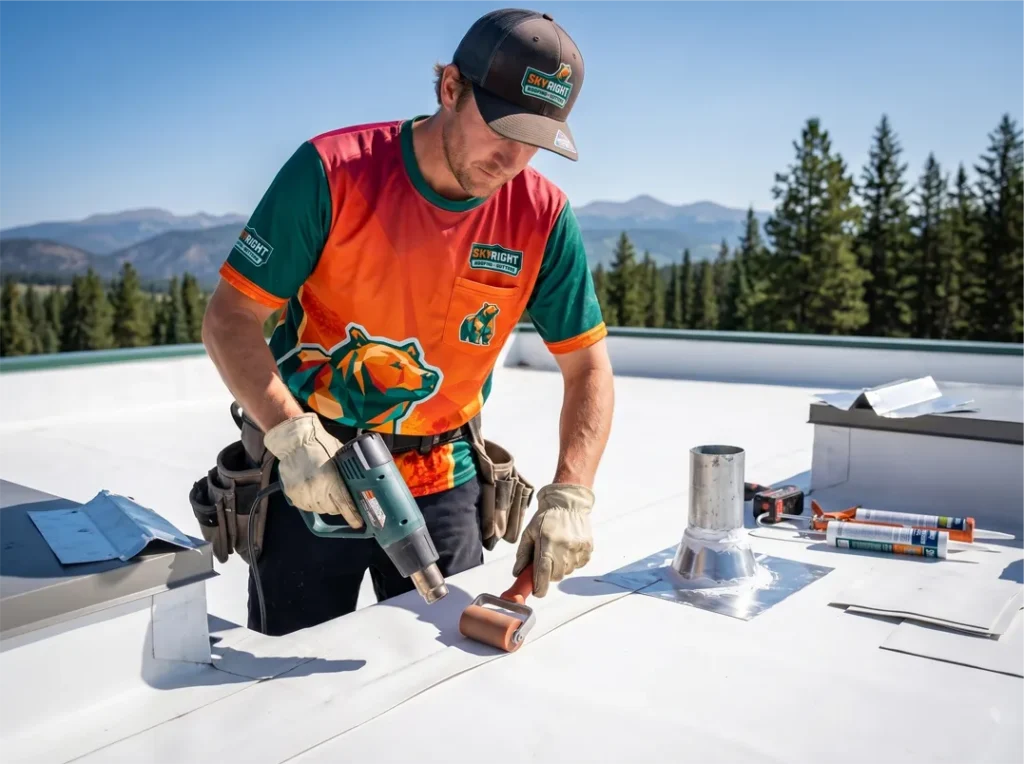
Commercial roofs should be inspected regularly because small problems can interrupt business operations.
Spring Checklist
- inspect winter damage;
- check drains and scuppers;
- look for ponding water;
- inspect seams;
- check rooftop unit flashing;
- document membrane punctures;
- remove debris;
- check gutter and downspout function;
- inspect roof edges and parapets.
Fall Checklist
- clean drains before winter;
- clear leaves and pine needles;
- check edge metal;
- inspect flashing before snow;
- review rooftop equipment supports;
- inspect walk pads;
- document roof condition before winter;
- schedule repairs before freeze-thaw season.
After-Storm Checklist
- photograph visible damage;
- check for displaced panels or edge metal;
- look for punctures from debris;
- inspect drains and scuppers;
- check for new interior stains;
- document storm date;
- schedule professional inspection if damage is visible.
For broader seasonal maintenance, read SkyRight’s North Idaho roof maintenance calendar.
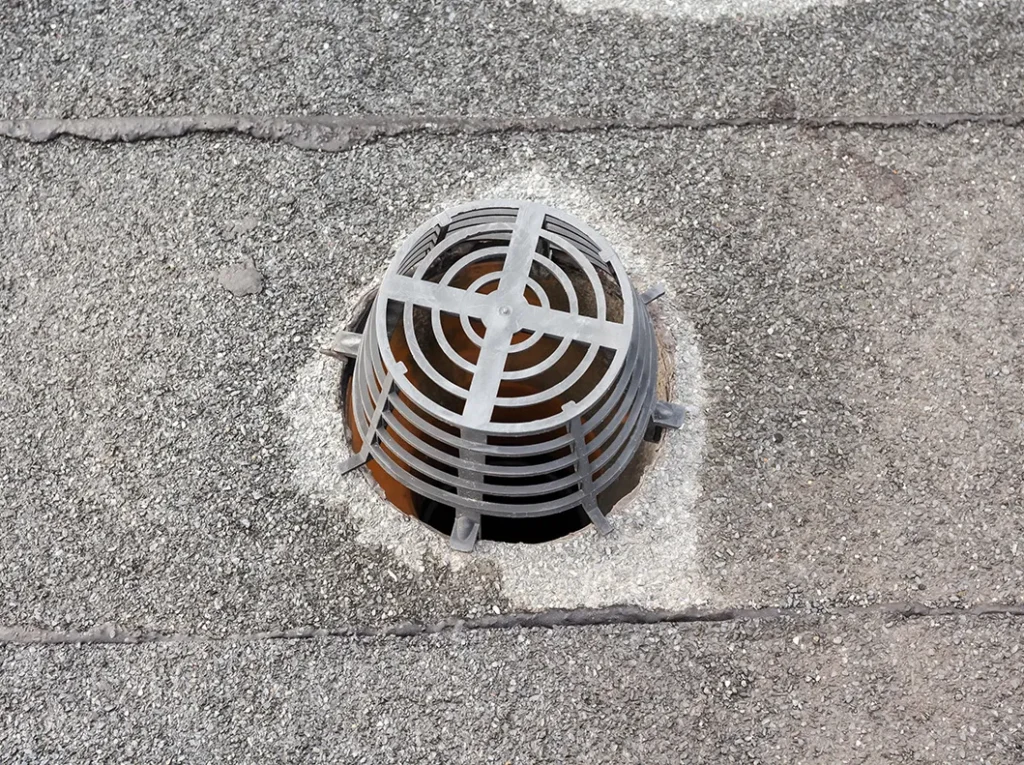
Drainage: The Most Important Flat Roof Detail
Drainage is one of the most important parts of a commercial flat roof. A premium membrane can still fail early if water cannot leave the roof.
Drainage Elements to Review
- roof slope;
- tapered insulation;
- internal drains;
- scuppers;
- gutters;
- downspouts;
- overflow drains;
- crickets behind rooftop units;
- parapet wall transitions;
- valley-like low areas;
- ponding water locations.
Ponding Water Warning Signs
- water remains long after rain;
- algae or dirt rings on the roof;
- sagging areas;
- wet insulation;
- recurring leaks in the same area;
- ice patches in winter;
- membrane seams below standing water;
- roof drains clogged with debris.
A flat roof estimate should not ignore drainage. In North Idaho, ponding water can freeze, expand, and create added stress during winter.
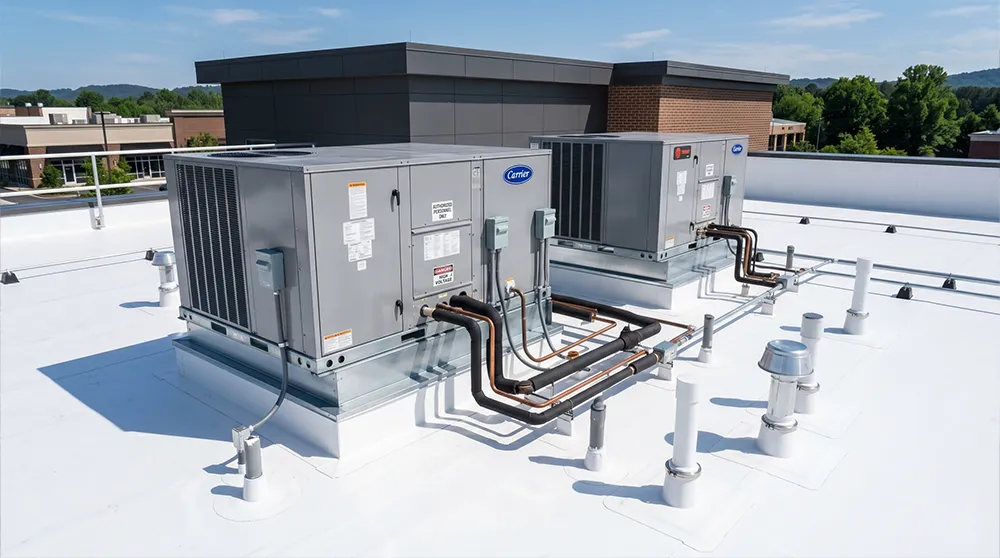
Rooftop Equipment and Penetrations
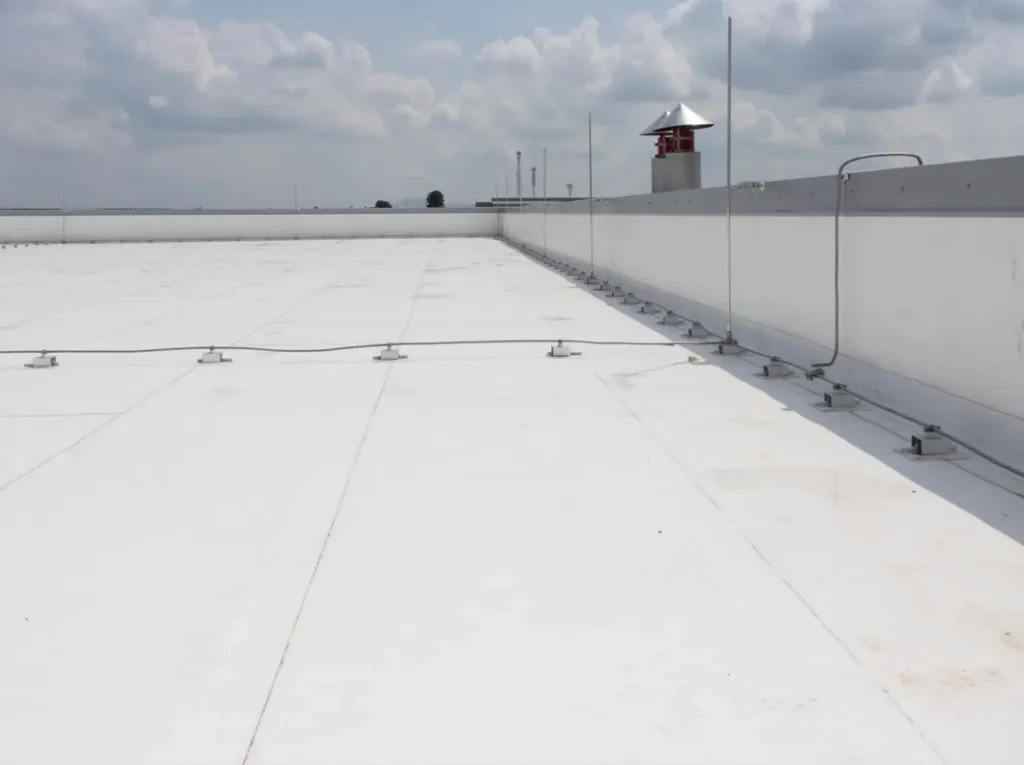
Commercial roofs often have HVAC units, exhaust fans, vents, pipes, conduits, satellite equipment, and service walk areas.
Each rooftop penetration creates a possible leak point.
Equipment Checklist
|
Item |
What to Check |
|
HVAC curbs |
Flashing, membrane tie-in, old sealant |
|
Exhaust fans |
Grease exposure, curb flashing, ponding nearby |
|
Pipes and vents |
Boots, pitch pockets, sealant, movement |
|
Supports |
Whether they rest properly without damaging membrane |
|
Walk pads |
Whether service paths are protected |
|
Conduit |
Whether fasteners or supports puncture the membrane |
|
Drains near equipment |
Whether debris blocks drainage |
|
Parapet-mounted equipment |
Wall flashing and coping conditions |
Restaurants, food-service buildings, and industrial spaces may need special attention because exhaust, grease, chemicals, or service traffic can affect roof system selection.
Insulation, R-Value, and Energy Performance
Commercial roof replacement is often the right time to evaluate insulation. Insulation affects energy performance, occupant comfort, condensation risk, and code compliance.
Insulation Questions to Ask
- What insulation is currently installed?
- Is the insulation wet?
- Is tapered insulation needed for drainage?
- Will replacement trigger code-required insulation upgrades?
- Does the building have condensation issues?
- Is the roof over conditioned or unconditioned space?
- Are there different roof sections with different insulation levels?
A lower roofing bid may be missing insulation upgrades or tapered drainage improvements.
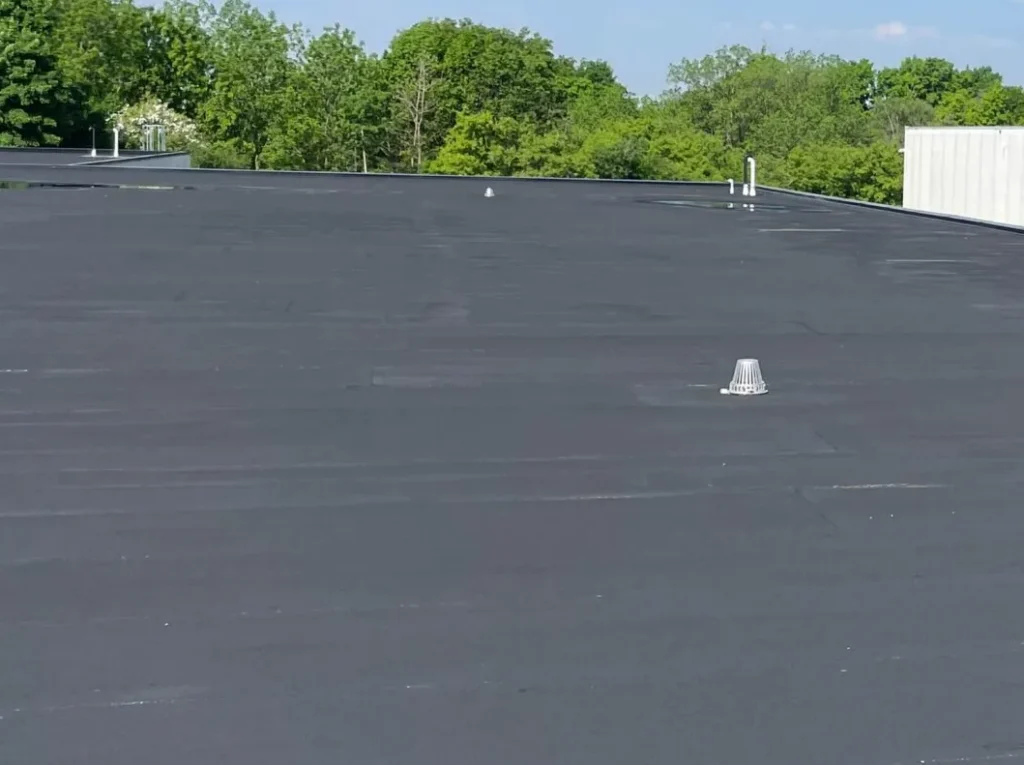
Warranties for Commercial Roofs
Commercial roof warranties can be more complex than residential warranties.
Warranty Types
|
Warranty Type |
What It Usually Relates To |
|
Manufacturer material warranty |
The roofing product or membrane |
|
Manufacturer system warranty |
The installed system if requirements are met |
|
Contractor workmanship warranty |
Installation labor under contractor terms |
|
Coating warranty |
Coating product and/or approved restoration scope |
|
Maintenance-based warranty terms |
Some coverage may depend on maintenance and documentation |
Warranty Questions to Ask
- What manufacturer is specified?
- What membrane thickness is included?
- What attachment method is included?
- What warranty term is proposed?
- Is the warranty material-only or system-based?
- Is labor included?
- Are punctures excluded?
- Are ponding water areas excluded?
- Is maintenance required?
- Is rooftop traffic covered?
- Are repairs transferable if the building is sold?
A commercial roof warranty is only useful if the roof is installed correctly, maintained properly, and documented.
North Idaho Commercial Roof Scenarios
These examples are planning scenarios, not quotes.
Scenario 1: Coeur d’Alene Retail Building With Ponding Water
Building profile: Low-slope commercial roof, several rooftop units, water remains near drains after rain.
Likely issue: Drainage and tapered insulation need review before selecting a membrane.
Best next step: Commercial roof inspection, drainage mapping, and repair vs replacement evaluation.
Why: Replacing the membrane without fixing ponding water may shorten the life of the new system.
Scenario 2: Post Falls Warehouse With Aging Membrane
Building profile: Large low-slope warehouse roof, recurring seam leaks, older membrane, limited foot traffic.
Likely system options: TPO, EPDM, PVC, or coating depending on moisture, seams, insulation, and deck condition.
Best next step: Moisture review and system comparison.
Why: If insulation is dry and the membrane is restorable, coating may be considered. If the roof is saturated or widely failing, replacement is more likely.
Scenario 3: Restaurant With Grease Exhaust
Building profile: Low-slope roof with kitchen exhaust, rooftop equipment, and service traffic.
Likely system options: PVC or another system designed for the exposure conditions.
Best next step: Inspect membrane condition, exhaust areas, rooftop unit flashing, and maintenance history.
Why: Grease and chemical exposure can affect roof material choice and warranty terms.
Scenario 4: Sandpoint Shop or Rural Commercial Building
Building profile: Sloped roof, snow exposure, open lot, owner wants durability.
Likely system options: Metal roofing or commercial-grade roof system depending on slope and building design.
Best next step: Evaluate roof pitch, snow-shedding paths, gutters, trim, fasteners, and access.
Why: Metal roofing can be strong in snowy conditions, but snow movement and drainage must be planned.
Scenario 5: Mixed-Use Building With Tenants
Building profile: Office or retail tenants below, active leak near rooftop HVAC unit.
Likely issue: Flashing or curb detail failure.
Best next step: Repair inspection and tenant-impact planning.
Why: Commercial leaks can interrupt business operations, damage inventory, and affect tenant relationships.
How to Compare Commercial Roofing Bids
Commercial roofing bids should be detailed. A vague “flat roof replacement” proposal is not enough.
Commercial Bid Checklist
Bid Item | What to Confirm |
Roof system | TPO, EPDM, PVC, mod bit, BUR, metal, coating, or hybrid |
Membrane thickness | Product line and thickness should be listed |
Attachment method | Mechanically attached, adhered, ballasted, induction welded, or other |
Tear-off scope | Full tear-off, recover, restoration, or partial replacement |
Insulation | Type, thickness, R-value, tapered design |
Moisture handling | Wet insulation removal and replacement method |
Drainage | Drains, scuppers, crickets, tapered insulation, ponding areas |
Edge metal | Perimeter termination and wind-resistance details |
Penetrations | HVAC curbs, pipes, vents, exhaust, conduit |
Walk pads | Rooftop service paths |
Warranty | Manufacturer and workmanship coverage |
Business operations | Access, staging, noise, odor, tenant communication |
Cleanup | Debris removal and daily site safety |
Exclusions | What is not included |

When to Schedule a Commercial Roof Inspection
Schedule a commercial roof inspection if you notice:
- interior stains;
- active leaks;
- roof ponding;
- clogged drains;
- membrane bubbles or blisters;
- open seams;
- punctures;
- rooftop unit leaks;
- edge metal movement;
- parapet wall cracks;
- recurring repair calls;
- tenant complaints;
- snow or ice buildup;
- storm damage;
- roof age concerns.
Do not wait until water damages inventory, drywall, electrical systems, insulation, or tenant spaces.
Final Recommendation: Design the Roof Around the Building
The best commercial roof in North Idaho is the roof system that matches the building.
A good commercial roofing plan should account for:
- roof slope;
- drainage;
- snow load;
- freeze-thaw cycles;
- insulation;
- rooftop equipment;
- business operations;
- foot traffic;
- existing roof condition;
- repair history;
- warranty goals;
- budget;
- long-term ownership plans.
TPO, EPDM, PVC, modified bitumen, built-up roofing, metal roofing, and coatings can all be good options in the right situation. The wrong system, or the right system installed over unresolved drainage or moisture problems, can become expensive quickly.
Ready to evaluate your commercial or flat roof? Schedule a commercial roofing inspection with SkyRight.
FAQ: Commercial & Flat Roofing Systems in North Idaho
What is the best flat roof system for a commercial building?
The best flat roof system depends on the building’s slope, drainage, insulation, rooftop equipment, budget, and exposure conditions. TPO, EPDM, PVC, modified bitumen, built-up roofing, metal roofing, and coatings can all be appropriate in different situations.
Is a flat roof supposed to be completely flat?
No. A flat roof should still have positive drainage. Low-slope roofs need controlled drainage through slope, tapered insulation, drains, scuppers, gutters, or other drainage features.
How much does commercial flat roofing cost?
For planning purposes, many commercial flat roof systems fall around $6–$14 per sq. ft. installed, while coatings may be lower and complex replacements or metal systems can cost more. Exact pricing depends on system type, insulation, tear-off, drainage, access, and rooftop equipment.
What is the difference between TPO and EPDM roofing?
TPO is a thermoplastic single-ply membrane commonly installed with heat-welded seams and reflective options. EPDM is a synthetic rubber membrane supplied in large sheets and commonly used on low-slope roofs. The better choice depends on building needs, budget, drainage, and exposure.
When should a commercial roof be replaced instead of repaired?
Replacement is usually better when leaks are recurring, insulation is saturated, membrane failure is widespread, seams are failing across large areas, ponding water is severe, or the roof is near the end of its service life.
Can a commercial roof coating replace a new roof?
Sometimes, but only if the existing roof is a good candidate. Coatings may extend service life when the membrane is sound, insulation is dry, and drainage is acceptable. Coatings are not a good fix for saturated insulation, structural damage, or widespread roof failure.
What causes commercial flat roof leaks?
Common causes include failed seams, clogged drains, rooftop HVAC flashing, punctures, edge metal problems, parapet wall transitions, ponding water, previous poor repairs, and freeze-thaw damage.
Are metal roofs good for commercial buildings?
Yes, metal roofing can be a strong option for sloped commercial buildings, shops, warehouses, agricultural buildings, and mixed-use properties. It works best when roof pitch, snow movement, gutters, trim, and penetrations are properly planned.
How often should a commercial roof be inspected?
Commercial roofs should be inspected at least seasonally and after major storms, heavy snow, high winds, or known leaks. Buildings with rooftop equipment, tenant spaces, or older roofs may need more frequent inspections.
Who provides commercial roofing in Coeur d’Alene and North Idaho?
SkyRight provides commercial roofing, flat roof evaluation, roof repair, roof replacement, metal roofing, gutter services, and maintenance guidance for businesses and property owners in Coeur d’Alene, Post Falls, Sandpoint, Hayden, Rathdrum, Athol, Spirit Lake, and nearby North Idaho communities.