
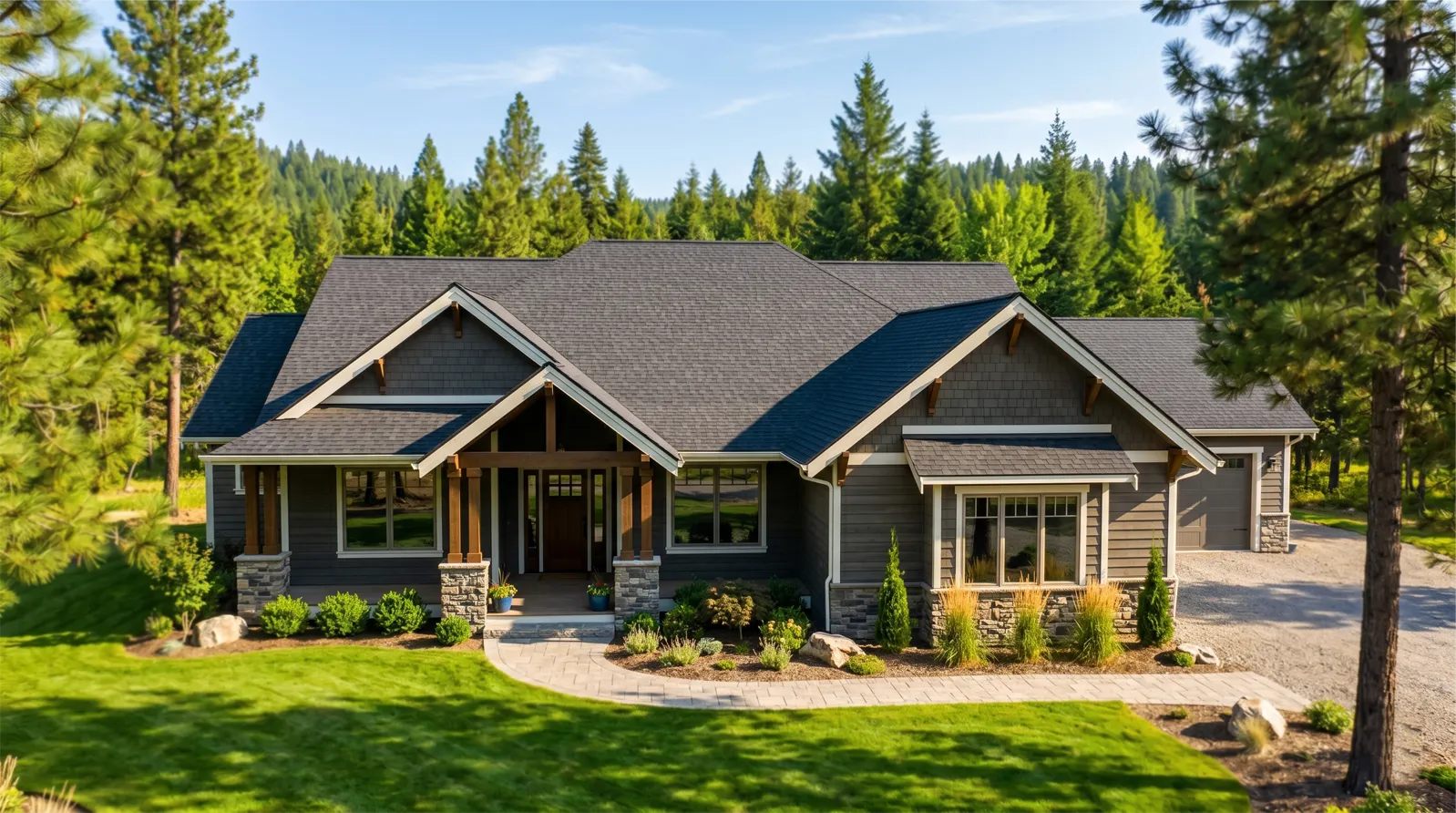
At a Glance: Best Asphalt Shingles for North Idaho Homes
For most North Idaho homes, architectural asphalt shingles are the best all-around residential roofing choice because they offer a strong balance of cost, durability, curb appeal, repairability, and weather performance.
In 2026, many asphalt shingle roof replacements fall around $500–$900 per roofing square for standard asphalt systems, while higher-end architectural, designer, or impact-resistant shingles may cost more depending on the roof design, tear-off, underlayment, flashing, ventilation, and decking condition. A roofing square equals 100 sq. ft. Published 2026 cost benchmarks commonly show asphalt shingles around $4–$10 per sq. ft. installed, with architectural shingles often landing above basic 3-tab shingles. These are planning ranges only; an accurate SkyRight estimate requires an on-roof inspection.
A good asphalt roof is not just “shingles.” A complete residential roofing system includes the roof deck, underlayment, leak barriers, starter shingles, field shingles, ridge caps, flashing, ventilation, fasteners, and drainage details. GAF’s residential roof system guidance similarly identifies leak barrier, roof deck protection, starter strips, shingles, rooftop accessories, attic ventilation, and ridge cap shingles as key roof components.
SkyRight helps homeowners in Coeur d’Alene, Post Falls, Sandpoint, Hayden, Rathdrum, Athol, Spirit Lake, and surrounding North Idaho communities choose the right asphalt roofing material for their home, budget, roof pitch, snow exposure, and long-term plans.
For local service help, visit SkyRight’s residential roofing services in Coeur d’Alene, roofing services in Post Falls, or Coeur d’Alene roofing page.
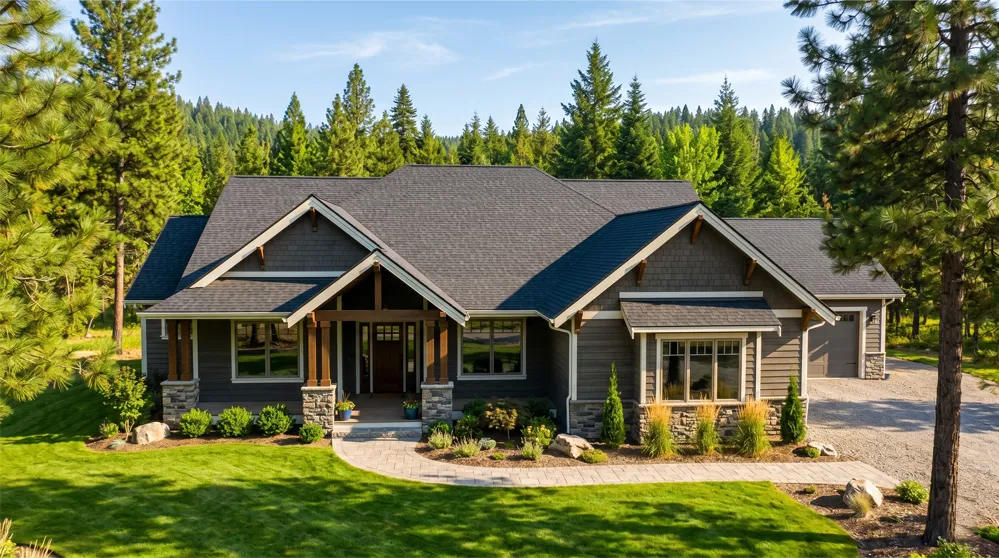
Quick Answer: What Are the Best Asphalt Shingles?
The best asphalt shingles for most North Idaho homeowners are usually architectural shingles, also called architectural laminate shingles or dimensional shingles.
They are often a better choice than basic 3-tab shingles because they usually provide:
- Better curb appeal with a thicker, dimensional look.
- Better wind performance options than basic flat 3-tab shingles.
- Better long-term value for most residential roof replacements.
- More color and style options for matching siding, trim, stone, brick, and neighborhood style.
- Better compatibility with modern roof system warranties when installed as part of a complete roofing system.
Basic 3-tab shingles can still work for certain budget-focused projects, but for most homes in North Idaho, architectural shingles are usually the better balance of cost, appearance, and performance.
For homeowners comparing asphalt against metal, read SkyRight’s metal roofing vs asphalt shingles guide or visit our metal roofing services page.
What Are Asphalt Shingles Made Of?
Modern asphalt shingles are commonly made from a fiberglass mat coated with asphalt and surfaced with protective mineral granules. IKO describes the core shingle layers as fiberglass, asphalt, granules, sealant, and release film.
In practical homeowner terms, each layer has a job.
|
Shingle Component |
What It Does |
Why It Matters |
|
Fiberglass mat |
Forms the reinforcing base of the shingle |
Helps provide structure and stability |
|
Asphalt coating |
Adds waterproofing and weather resistance |
Helps the shingle shed water |
|
Mineral granules |
Protect the surface from sun and weather |
Helps with color, UV resistance, and surface durability |
|
Sealant strip |
Bonds shingles together after installation |
Helps reduce wind lift when properly activated |
|
Release film |
Keeps shingles from sticking in the bundle |
Helps with packaging and installation |
A homeowner should not choose a roof based only on the visible shingle color. The hidden layers, accessories, ventilation, and installation details often determine whether the roof performs well over time.
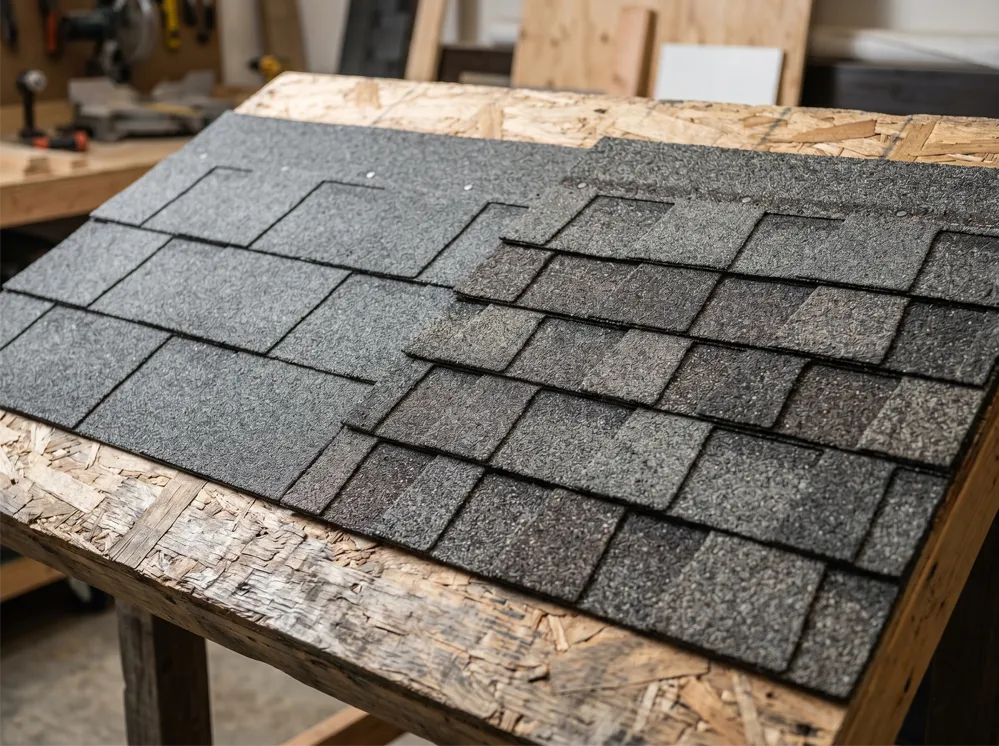
Architectural Shingles vs 3-Tab Shingles
The two most common asphalt shingle categories are 3-tab shingles and architectural shingles.
3-tab shingles are flat, lighter, and usually less expensive. Architectural shingles are thicker, dimensional, and usually built for better curb appeal and stronger performance options. Many roofing industry comparisons describe architectural shingles as heavier and more substantial than 3-tab shingles, which is one reason they are commonly chosen for residential replacements.
|
Feature |
3-Tab Shingles |
Architectural Shingles |
|
Appearance |
Flat, uniform, basic look |
Dimensional, thicker, more textured |
|
Upfront cost |
Usually lower |
Usually higher than 3-tab |
|
Long-term value |
Lower for many homes |
Often better for owner-occupied homes |
|
Wind performance |
Usually more limited |
Often stronger product options |
|
Curb appeal |
Basic |
Stronger visual upgrade |
|
Repair matching |
Can be harder as older 3-tab lines become less common |
Usually easier with modern residential product lines |
|
Best fit |
Budget projects, simple structures, short-term ownership |
Most North Idaho residential roof replacements |
Which One Should North Idaho Homeowners Choose?
For most homes in Coeur d’Alene, Post Falls, Sandpoint, Hayden, Rathdrum, and nearby areas, architectural shingles are usually the better default choice.
They make the most sense when:
- the home is owner-occupied;
- curb appeal matters;
- the homeowner plans to stay for several years;
- the roof has visible slopes from the street;
- wind and weather performance matter;
- the homeowner wants better resale presentation;
- the roof replacement is already a major investment.
3-tab shingles may still make sense when:
- the budget is extremely tight;
- the structure is simple;
- the project is temporary;
- the building is not a primary residence;
- the homeowner understands the performance tradeoffs.
For a deeper comparison, visit SkyRight’s guide to architectural laminate vs 3-tab asphalt shingles.

Asphalt Shingle Cost Ranges
Asphalt shingles are usually one of the most cost-effective residential roofing materials. However, the final installed price depends on much more than the shingle bundle.
For planning purposes in North Idaho:
|
Asphalt Roofing Option |
Planning Cost Per Roofing Square |
Typical Use Case |
|
Basic 3-tab shingles |
$500–$750 per square |
Budget-focused projects, simple roofs |
|
Architectural shingles |
$600–$900 per square |
Most residential roof replacements |
|
Premium architectural shingles |
$750–$1,100+ per square |
Better appearance, enhanced options, more complex roofs |
|
Designer or luxury asphalt shingles |
$900–$1,500+ per square |
High-end curb appeal, specialty profiles |
|
Impact-resistant asphalt shingles |
$800–$1,300+ per square |
Homeowners prioritizing storm-resistance options |
Important pricing disclaimer: These are general planning ranges, not a SkyRight quote. Roof pitch, tear-off, old layers, decking repairs, ventilation, flashing, underlayment, roof access, skylights, chimneys, valleys, and current material prices can all change the final cost. The exact price requires a professional roof inspection.
For a broader roof replacement pricing guide, read SkyRight’s North Idaho roof replacement cost guide.
Ready for an accurate estimate?
Budgeting for a new roof shouldn’t be a guessing game. Every house in North Idaho has its own unique layout, pitch, and square footage.
What Affects the Cost of Asphalt Shingle Roofing?
The shingle itself is only one part of the roof replacement cost. A lower-cost shingle on a complicated roof can cost more than a better shingle on a simple roof.
|
Cost Factor |
Why It Matters |
|
Roof size |
More square footage means more shingles, underlayment, fasteners, labor, and disposal |
|
Roof pitch |
Steeper roofs require more safety setup and slower installation |
|
Tear-off |
Removing old shingles adds labor and dump fees but exposes hidden damage |
|
Old roof layers |
Multiple layers take longer to remove and can hide moisture problems |
|
Decking condition |
Soft or damaged sheathing must be replaced before new shingles go on |
|
Valleys and transitions |
Valleys, sidewalls, dormers, skylights, and chimneys require detailed waterproofing |
|
Underlayment choice |
Synthetic underlayment, ice and water protection, and leak barriers affect performance and cost |
|
Starter and ridge accessories |
Proper starter strips and ridge caps help the system perform as designed |
|
Ventilation |
Poor attic ventilation can shorten roof life |
|
Gutters and drainage |
Bad drainage can send water back toward roof edges, fascia, siding, or foundation |
|
Access |
Tight driveways, landscaping, steep lots, and rural properties can increase labor complexity |
SkyRight also provides gutter services for homeowners who need to address roof drainage as part of a larger exterior system.
Best Asphalt Shingle Features for North Idaho Weather
North Idaho roofs deal with snow, rain, wind, freeze-thaw cycles, shaded tree cover, summer heat, wildfire smoke, and seasonal moisture. The best shingle for this region is not just the one with the nicest color.
Look for a roofing system that addresses these conditions.
|
North Idaho Condition |
Material or System Feature to Prioritize |
|
Snow and ice |
Ice and water protection at eaves, valleys, and leak-prone areas |
|
Wind exposure |
Quality starter strips, correct nailing, strong sealant bond, suitable shingle rating |
|
Heavy rain |
Proper flashing, valleys, drip edge, underlayment, and drainage |
|
Shaded roofs |
Algae-resistant shingles and proper ventilation |
|
Tree debris |
Regular maintenance, clean gutters, and durable surface granules |
|
Freeze-thaw cycles |
Good attic ventilation, flashing, underlayment, and roof edge detailing |
|
Summer heat |
Balanced ventilation and appropriate color selection |
|
Rural properties |
Stronger underlayment, access planning, and snow-shedding considerations |
A roof that performs well in North Idaho is built as a system. The best shingle cannot compensate for poor flashing, bad ventilation, skipped starter strips, or damaged decking.
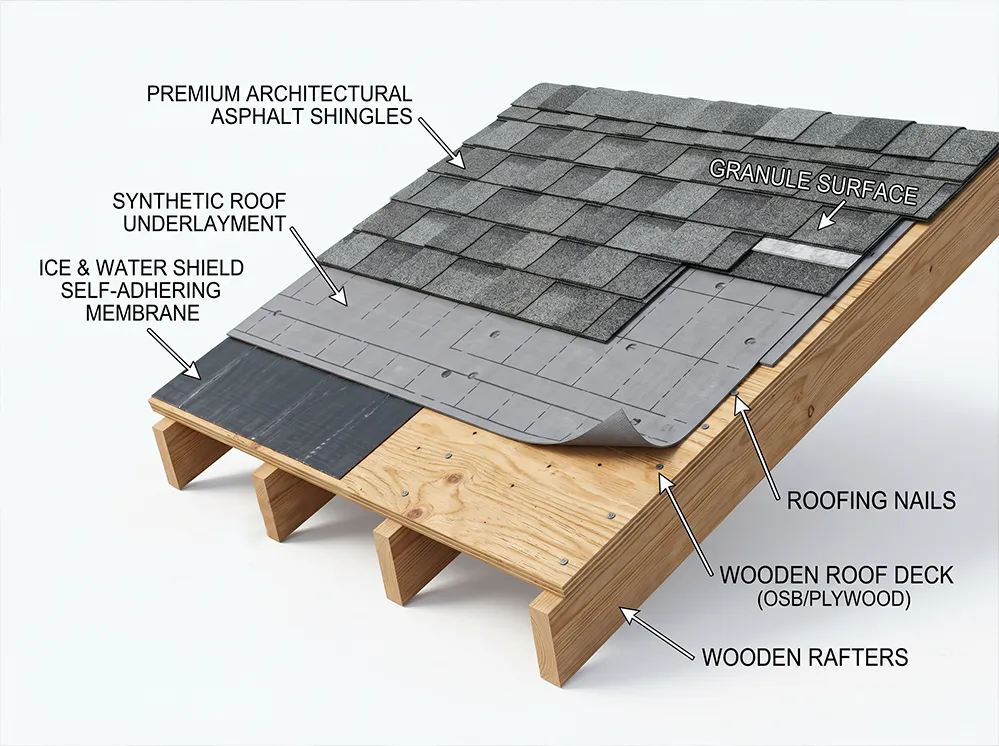
Asphalt Roof System Components
A durable asphalt roof includes more than field shingles. The system layers matter.
|
Roof Component |
Purpose |
What Homeowners Should Ask |
|
Roof deck |
Structural surface under the roof system |
Is any sheathing soft, rotten, or delaminated? |
|
Drip edge |
Directs water away from fascia and roof edges |
Is new drip edge included? |
|
Ice and water protection |
Helps protect vulnerable leak areas |
Where will it be installed? |
|
Synthetic underlayment |
Secondary water-shedding layer |
What type of underlayment is included? |
|
Starter shingles |
Help seal roof edges and reduce wind uplift |
Are true starter strips being used? |
|
Field shingles |
Main visible roofing surface |
Which shingle line and color? |
|
Valley treatment |
Protects high-water-flow roof valleys |
Is the valley open, closed, or woven? |
|
Flashing |
Protects chimneys, walls, vents, and transitions |
Will flashing be replaced or reused? |
|
Pipe boots and vents |
Seal roof penetrations |
Are old boots being replaced? |
|
Ridge cap shingles |
Finish and protect hips and ridges |
Are matching ridge caps included? |
|
Ventilation |
Balances attic heat and moisture |
Is intake and exhaust ventilation balanced? |
For more detail on individual components, read SkyRight’s articles about starter shingles, ridge cap options, flashing for asphalt shingle roofs, and roof and attic ventilation.
Why Starter Shingles Matter
Starter shingles are installed at the edges of the roof before the main field shingles. They help seal the first row of shingles and reduce the risk of wind getting underneath the roof edge.
Skipping proper starter strips is a common shortcut that can create problems later.
A proper starter system helps with:
- cleaner roof edges;
- better wind resistance at eaves and rakes;
- better alignment for the first shingle courses;
- stronger sealing at vulnerable edges;
- better manufacturer-system compatibility.
This is especially important in open areas around Post Falls, Rathdrum, Athol, and rural North Idaho properties where wind exposure can vary from lot to lot.
Why Ridge Caps Matter
Ridge cap shingles cover the hips and ridges of the roof. These areas are exposed to wind, weather, and visual attention.
Using cut-up field shingles as ridge caps may look cheaper, but it is not always the best choice. Purpose-made ridge cap shingles often provide a cleaner appearance and better compatibility with the roof system.
Good ridge caps help:
- protect roof peaks and hips;
- finish the roof visually;
- support system warranty requirements;
- match or complement the field shingle color;
- reduce weak points at high-exposure areas.
For homes with highly visible rooflines in Coeur d’Alene, Hayden Lake, Sandpoint, and Post Falls, ridge cap choice can affect both performance and curb appeal.
Underlayment and Ice Protection
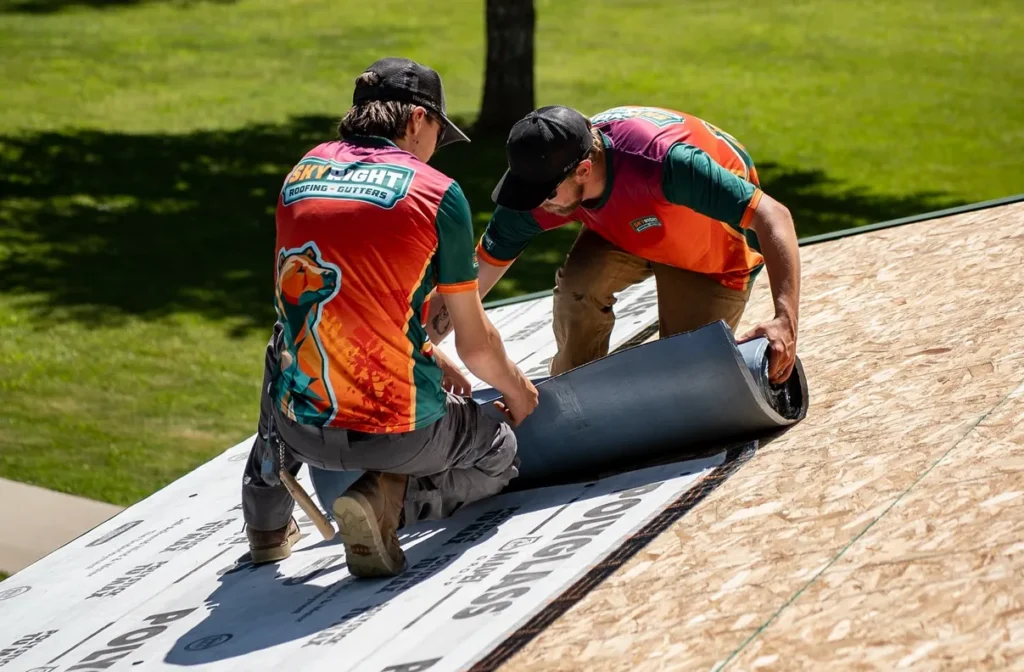
Underlayment is the layer between the shingles and roof deck. It helps provide a secondary layer of protection if water gets under the shingles.
North Idaho homeowners should pay special attention to:
- eaves;
- valleys;
- dormers;
- skylights;
- chimneys;
- low-slope transitions;
- roof-to-wall intersections;
- areas where snow and ice collect.
Ice and water protection is especially important in areas where snowmelt can refreeze near the roof edge. It does not replace good ventilation or proper roof design, but it helps protect vulnerable areas.
Ventilation: The Hidden Part of Shingle Performance
A shingle roof can fail early if the attic is poorly ventilated. Heat and moisture buildup can contribute to condensation, deck damage, mold concerns, ice dam issues, and premature shingle aging.
Balanced ventilation usually includes:
- intake ventilation near the lower roof edge;
- exhaust ventilation near the ridge or upper roof area;
- clear air pathways through the attic;
- no blocked soffit vents;
- roof design that supports consistent airflow.
A roofing estimate should not only mention shingles. It should also explain whether the attic ventilation appears adequate.
For more detail, read SkyRight’s guide to different types of roof and attic ventilation.
Choosing the Best Asphalt Shingle Color
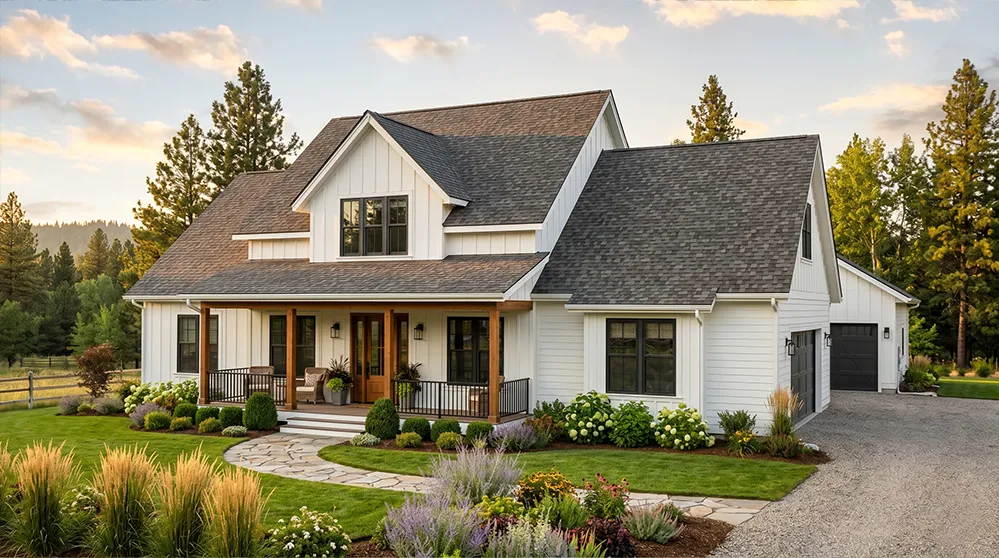
Shingle color affects curb appeal, resale presentation, heat absorption, and how the home fits into the surrounding neighborhood.
In North Idaho, popular asphalt shingle color families often include:
|
Color Family |
Best Fit |
|
Charcoal / black |
Modern homes, white siding, gray siding, strong contrast |
|
Weathered wood |
Versatile homes, natural exteriors, craftsman styles |
|
Brown / driftwood |
Earth-tone siding, stone, wood accents, rustic homes |
|
Gray blends |
Contemporary homes, lake homes, blue or white siding |
|
Green or forest tones |
Cabins, wooded lots, rural properties |
|
Light gray |
Homes where heat absorption and softer contrast matter |
Color selection should consider the roof’s visibility from the street, siding color, trim, stonework, gutters, garage doors, and landscaping.
For more help, read SkyRight’s guide to choosing the best roof shingle color for your home.
Asphalt Shingle Warranty: What Homeowners Should Know
A “lifetime shingle warranty” does not mean every roof problem is covered forever.
Warranty coverage can depend on:
- the product line;
- whether the full roof system was installed;
- ventilation requirements;
- installation method;
- nail placement;
- roof pitch;
- maintenance;
- transfer rules;
- algae coverage limitations;
- workmanship warranty terms;
- manufacturer exclusions.
Homeowners should ask two separate warranty questions:
- What does the manufacturer warranty cover?
- What does the contractor workmanship warranty cover?
The manufacturer warranty relates to the product. The workmanship warranty relates to installation. Both matter.
A premium shingle installed with poor ventilation, weak flashing, bad nail placement, missing starter strips, or damaged decking can still fail.
For more detail, read SkyRight’s article on what is included in an asphalt shingle roof lifetime warranty.
North Idaho Asphalt Shingle Material Scenarios
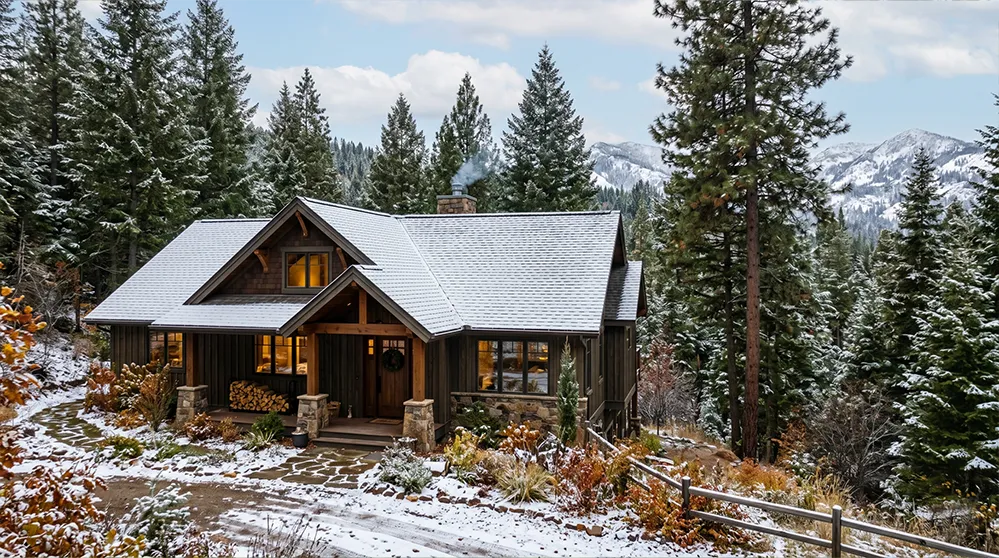
These examples are planning scenarios, not quotes. They show how the right asphalt material choice changes depending on the home.
Scenario 1: Coeur d’Alene Home Replacing Old 3-Tab Shingles
Home profile: 1,700 sq. ft. roof surface, moderate pitch, older 3-tab shingles, visible street-facing roof slopes, no major decking damage.
Likely material recommendation: Architectural asphalt shingles.
Planning budget range: Around $10,000–$18,000, depending on tear-off, underlayment, flashing, roof access, and ventilation needs.
Why it makes sense: Architectural shingles improve the home’s appearance, usually offer better long-term value than 3-tab, and are a practical fit for many residential homes in Coeur d’Alene.
Scenario 2: Post Falls Home With Wind Exposure
Home profile: 2,000 sq. ft. roof surface, open lot, multiple roof edges, wind exposure, older asphalt shingles with lifting or missing tabs.
Likely material recommendation: Architectural shingles with proper starter strips, strong edge detailing, upgraded underlayment in vulnerable areas, and a ventilation review.
Planning budget range: Around $12,000–$22,000, depending on pitch, tear-off, decking, flashing, and edge details.
Why it makes sense: On exposed lots, the roof edge system matters. Starter strips, correct nailing, sealant activation, and quality installation are just as important as the shingle brand.

Scenario 3: Sandpoint or Rural North Idaho Home With Snow and Tree Cover
Home profile: 1,800–2,200 sq. ft. roof surface, shaded roof areas, snow exposure, tree debris, possible moss or algae growth, more complex property access.
Likely material recommendation: Architectural shingles or premium architectural shingles with algae-resistant options, upgraded leak protection in valleys and eaves, proper ventilation, and strong drainage planning.
Planning budget range: Around $14,000–$26,000+, depending on roof complexity and hidden deck conditions.
Why it makes sense: Snow, shade, and tree debris can shorten roof life if the system is not detailed correctly. The shingle choice matters, but ventilation, underlayment, valleys, and gutters matter just as much.
Scenario 4: Homeowner Comparing Asphalt Shingles vs Metal Roofing
Home profile: North Idaho homeowner planning a long-term roof replacement and comparing architectural shingles with metal roofing.
Likely material recommendation: Architectural asphalt shingles if budget, repairability, and traditional curb appeal are the priorities. Metal roofing may be worth considering if long-term durability, snow shedding, and material upgrade are the priorities.
Planning budget range: Asphalt shingles often fall below metal roofing upfront. Metal roofing can cost significantly more depending on panel type, trim, snow-management details, and roof complexity.
Why it makes sense: Asphalt is often the practical choice for many residential replacements, while metal is often the premium long-term material conversation.
Don’t let North Idaho winters catch your roof off guard
Choosing the wrong shingle grade can lead to ice dams and costly leaks when the snow hits. Let our team help you select the perfect impact-resistant roofing system tailored for the Coeur d’Alene and Sandpoint climate.
Asphalt Shingles vs Metal Roofing
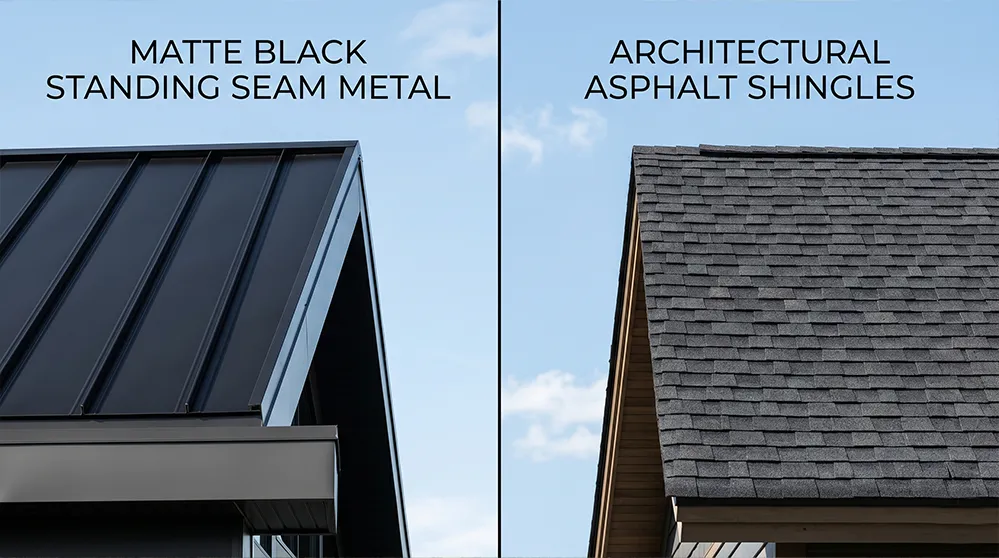
Asphalt shingles and metal roofing can both work well in North Idaho, but they serve different homeowner priorities.
|
Category |
Asphalt Shingles |
Metal Roofing |
|
Upfront cost |
Usually lower |
Usually higher |
|
Appearance |
Traditional residential look |
Modern, rural, cabin, or premium look |
|
Repairability |
Often easier to repair in small areas |
Repairs can be more specialized |
|
Snow shedding |
Moderate |
Often stronger, depending on panel and pitch |
|
Noise concerns |
Familiar sound profile |
Proper installation helps manage noise |
|
Lifespan potential |
Good with quality installation and maintenance |
Often longer with the right system |
|
Best fit |
Most residential budgets and neighborhoods |
Long-term ownership, snow exposure, premium upgrades |
For many North Idaho homeowners, the right answer is not “asphalt or metal is always better.” The right answer depends on the home, roof design, budget, neighborhood, snow exposure, and ownership timeline.
When Asphalt Shingles Are a Good Fit
Asphalt shingles are usually a strong fit when the homeowner wants:
- a practical roof replacement budget;
- traditional curb appeal;
- many color options;
- easier future repairs;
- good performance without the highest upfront cost;
- a familiar material for residential neighborhoods;
- a roof that can be installed efficiently by an experienced crew.
Asphalt shingles are especially common for residential homes in Coeur d’Alene, Post Falls, Hayden, Rathdrum, Spirit Lake, and Sandpoint.
When Asphalt Shingles May Not Be the Best Fit
Asphalt shingles may not be the best option if:
- the homeowner wants the longest possible material lifespan;
- the property has extreme snow-shedding needs;
- the roof has very low-slope sections;
- the owner strongly prefers a metal-roof appearance;
- wildfire-resilience goals or building requirements point toward another system;
- the structure is commercial or has flat roofing needs.
In those cases, metal roofing, flat roofing, or another system may be more appropriate. SkyRight can help compare options based on the actual roof.
Warning Signs Your Asphalt Shingle Roof May Need Replacement
A roof inspection is recommended if you notice:
- missing shingles;
- lifted or creased shingles;
- curling or cracking;
- heavy granule loss;
- exposed fiberglass mat;
- repeated leaks;
- soft decking;
- algae or moss spreading across shaded areas;
- shingles blowing off in moderate wind;
- old flashing failures;
- attic moisture;
- ice dam history;
- roof age approaching the end of its useful life.
If the damage is isolated, repair may be enough. If problems are widespread, replacement may be the better long-term decision.
For help deciding, read SkyRight’s guide on roof repair vs roof replacement.

How to Compare Asphalt Shingle Roofing Estimates
Do not compare roof estimates only by the final number. Compare the full system.
A strong asphalt shingle estimate should explain:
- shingle brand and product line;
- color selection;
- tear-off scope;
- number of existing roof layers;
- underlayment type;
- ice and water protection locations;
- starter shingles;
- ridge cap shingles;
- flashing replacement;
- pipe boot replacement;
- ventilation assessment;
- decking repair pricing;
- cleanup and magnet sweep;
- warranty details;
- payment schedule;
- timeline;
- change-order process.
A low bid may not be a bad bid, but a vague bid is risky. The estimate should make it clear what roof system is actually being installed.
Best Recommendation for North Idaho Homeowners
For most North Idaho homes, architectural asphalt shingles are the best starting point. They offer a strong balance of appearance, performance, cost, and long-term value.
The final decision should consider:
- roof pitch;
- home style;
- budget;
- wind exposure;
- snow exposure;
- shade and tree cover;
- attic ventilation;
- roof age;
- decking condition;
- resale goals;
- whether the homeowner is also considering metal roofing.
The best roof is not just the best shingle. It is the best complete system for that specific home.
Ready to choose the right asphalt shingle roof for your home? Schedule a roof inspection with SkyRight.
FAQ: Asphalt Shingles and Residential Roofing Materials
What are the best asphalt shingles for North Idaho homes?
For most North Idaho homes, architectural asphalt shingles are the best all-around option because they balance cost, durability, curb appeal, and weather performance. They are usually a better long-term choice than basic 3-tab shingles for owner-occupied homes.
Are architectural shingles better than 3-tab shingles?
Yes, for most residential roof replacements, architectural shingles are usually better than 3-tab shingles. They typically have a thicker dimensional profile, better curb appeal, stronger performance options, and better long-term value.
How much do asphalt shingles cost in North Idaho?
For planning purposes, many asphalt shingle roof replacements fall around $500–$900 per roofing square, depending on material type, roof pitch, tear-off, decking, flashing, ventilation, and access. Premium or designer asphalt shingles can cost more. A roofing square equals 100 sq. ft.
What is the difference between architectural and laminate shingles?
Architectural shingles and laminate shingles usually refer to the same general product category. They are also called dimensional shingles because they use layered construction to create a thicker, more textured appearance than flat 3-tab shingles.
Are asphalt shingles good for snow?
Asphalt shingles can perform well in snowy climates when installed as part of a complete roof system with proper underlayment, ice and water protection, flashing, ventilation, and drainage. The roof system matters as much as the shingle itself.
What color shingles are best for North Idaho homes?
The best shingle color depends on siding, trim, stone, gutters, neighborhood style, and roof visibility. Charcoal, weathered wood, brown blends, gray blends, and forest tones are all common choices for North Idaho homes.
Do asphalt shingles need special ventilation?
Yes. Proper attic ventilation helps manage heat and moisture, which can affect shingle life, attic condensation, ice dam risk, and overall roof performance. A roof estimate should include a ventilation review.
What is included in an asphalt shingle roof system?
A complete asphalt shingle roof system can include roof decking, drip edge, underlayment, ice and water protection, starter shingles, field shingles, ridge caps, flashing, pipe boots, ventilation, and cleanup. The exact scope should be listed in the estimate.
Should I choose asphalt shingles or metal roofing?
Choose asphalt shingles if you want a practical upfront cost, traditional curb appeal, many color choices, and easier repairability. Consider metal roofing if you want a premium long-term material, stronger snow-shedding potential, and a different visual style.
Who installs asphalt shingle roofing in Coeur d’Alene and Post Falls?
SkyRight installs and evaluates residential roofing systems in Coeur d’Alene, Post Falls, Sandpoint, Hayden, Rathdrum, Athol, Spirit Lake, and nearby North Idaho communities.